\[
\newcommand{\ZZ}{\mathbb{Z}}
\newcommand{\QQ}{\mathbb{Q}}
\newcommand{\RR}{\mathbb{R}}
\newcommand{\PP}{\mathbb{P}}
\newcommand{\SL}{\mathrm{SL}}
\newcommand{\PSL}{\mathrm{PSL}}
\]
![]()
Illustrating Mathematics
for Math 2.0
Katherine E. Stange · University of Colorado Boulder
De-centering problem solving
Problem solving, while historically one of the most visible goals of research mathematics, is only a proxy for more valuable long-term goals.
This proxy was largely accurate in the era of proof scarcity, but has become misaligned in the era of proof abundance.
The future of mathematics — “Math 2.0” — will require both expanding the research frontier, while simultaneously decentering the traditional role of problem solving.
— T. Tao, Math 2.0
“The primary bottleneck to achieving ‘Math 2.0’ is not technology, or even institutional culture.
It is imagination.”
— T. Tao, Math 2.0
Some of Tao’s “Math 2.0” uses of AI
- Open exposition problems: better proofs.
- Building a living network of results (e.g. the Integrated Explicit Analytic Number Theory Network).
- Experimental Mathematics at large-scale.
- Ablation studies and theorem neighbourhoods: variations on theorems.
- Mathlib
- Finding and highlighting new principles, methods, or insights, rather than merely new proofs.
- Interactive exposition.
“We humans have a wide range of abilities that help us perceive and analyze mathematical content. We perceive abstract notions not just through seeing but also by hearing, by feeling, by our sense of body motion and position. Our geometric and spatial skills are highly trainable, just as in other high-performance activities. In mathematics we can use the modules of our minds in flexible ways — even metaphorically. A whole-mind approach to mathematical thinking is vastly more effective than the common approach that manipulates only symbols.”
— William Thurston
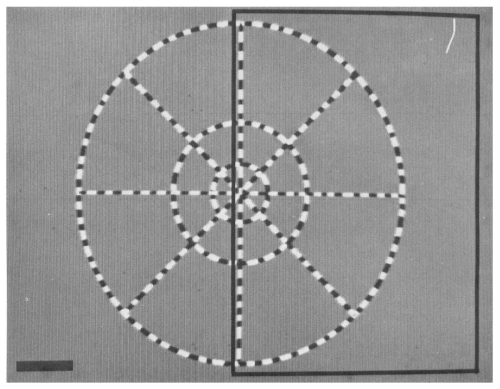
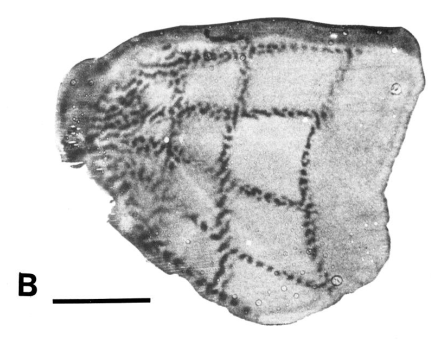
Our visual cortex is built for space, motion, colour, navigation, …
Source: Functional Anatomy of Macaque Striate Cortex. II. Retinotopic Organization, Tootell et al., The Journal of Neuroscience, 1988.
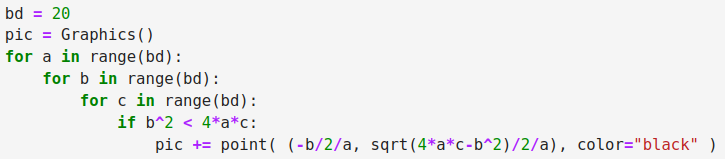
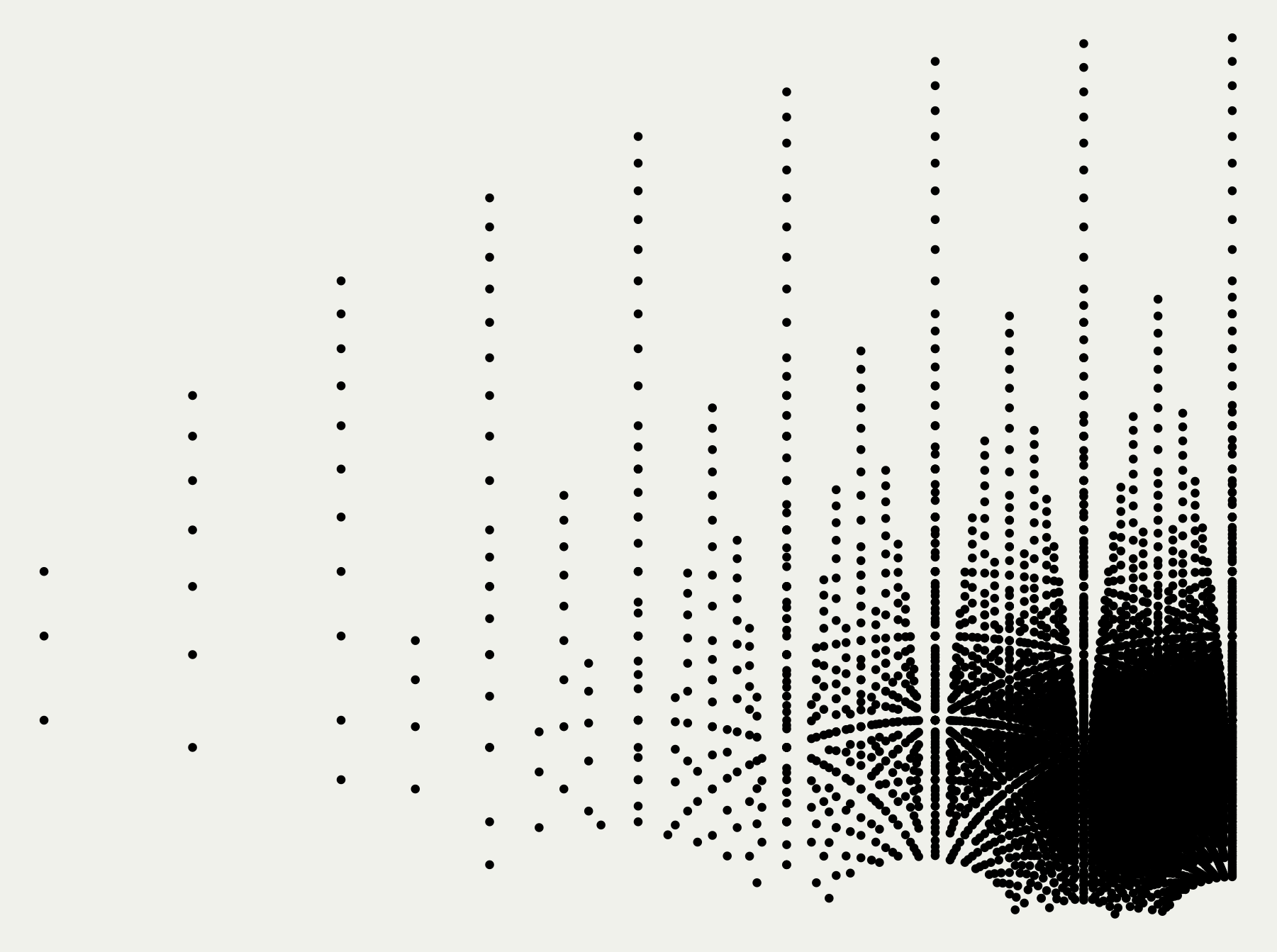
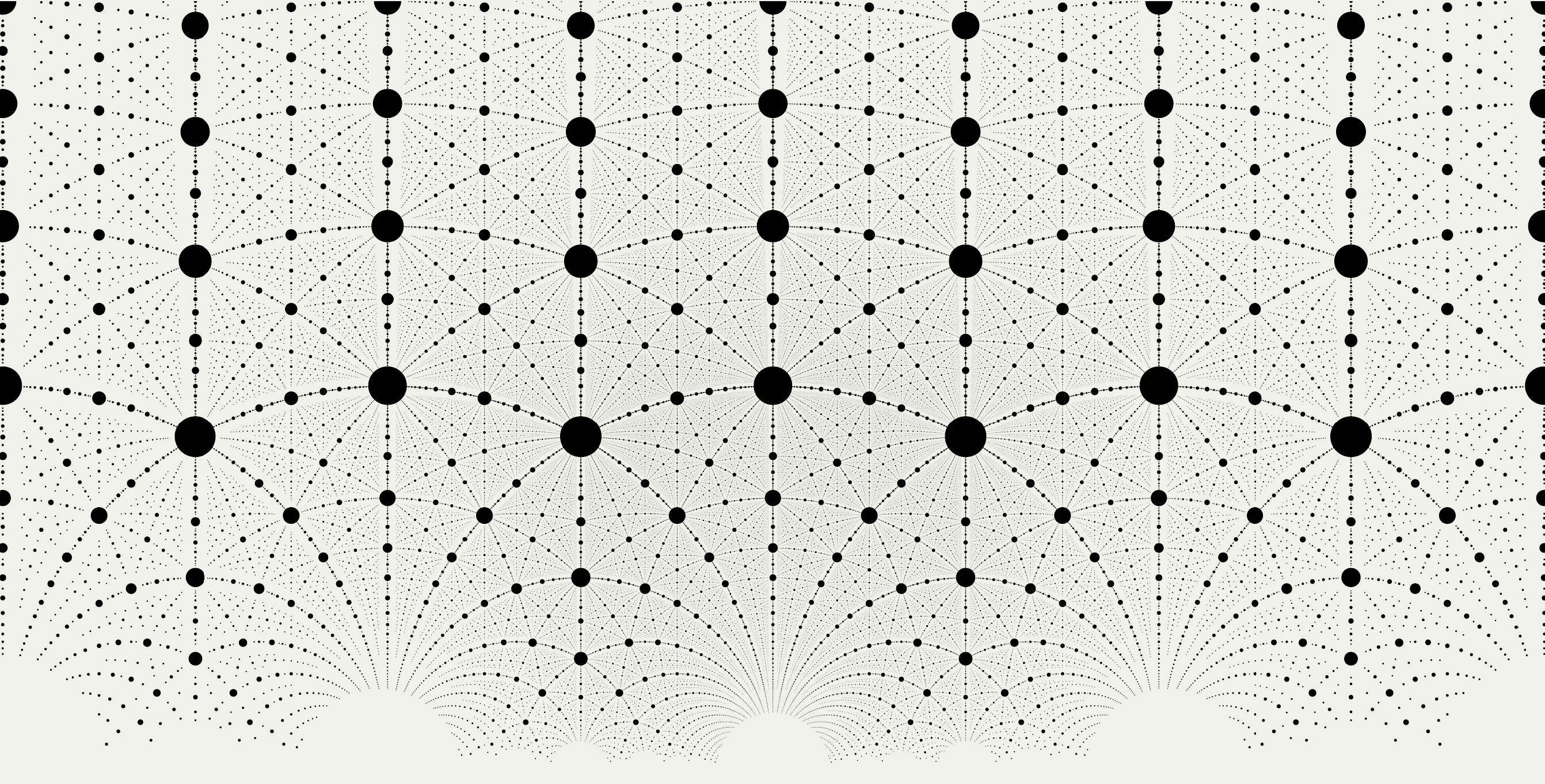
The quadratics,
the roots of \(ax^2 + bx + c = 0\) in the complex plane, \(a,b,c \in \ZZ\),
are dense.
![]()
Image joint with Edmund Harriss and Steve Trettel
![]()
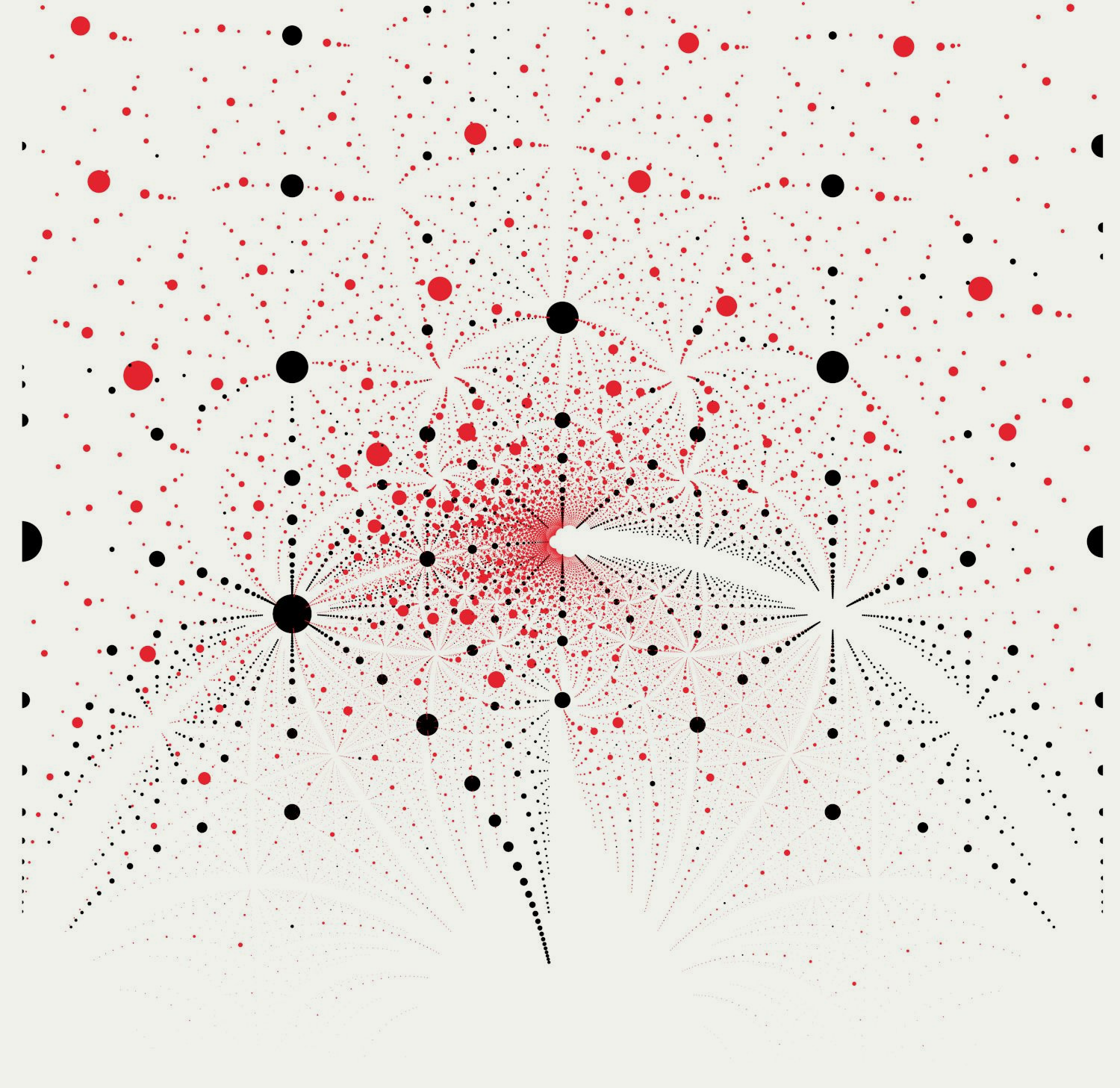
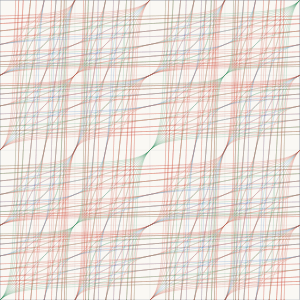
A parametrized family of cubics: roots of \(ax^3+(c+1)x^2+bx+c\), \(a,b,c\in\ZZ\)
Image joint with Edmund Harriss and Steve Trettel
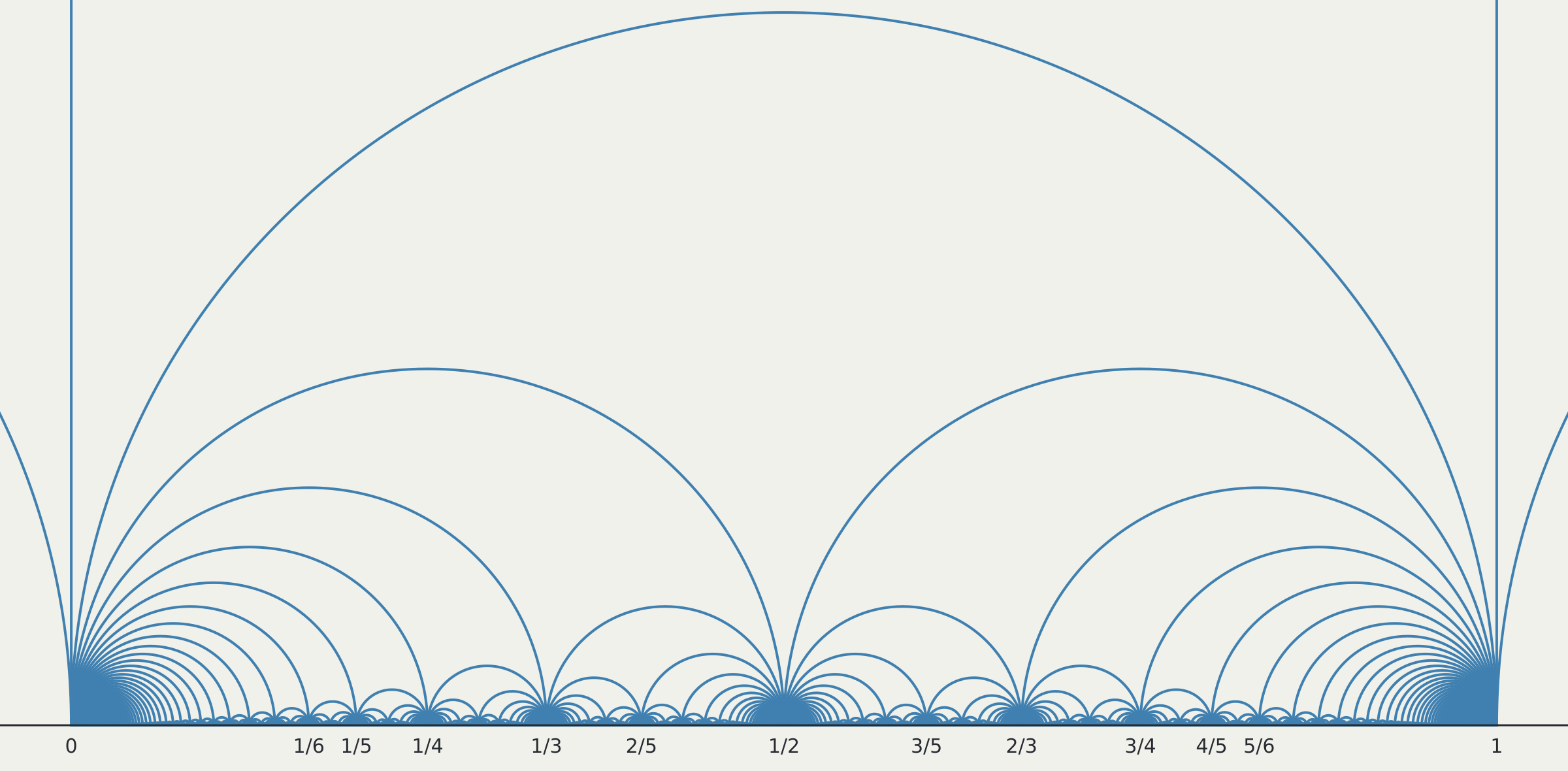
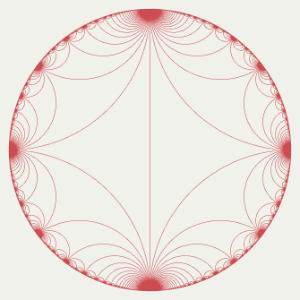
Farey tessellation
![]()
\[ \frac{a}{b} \rightarrow \frac{a+c}{b+d} \leftarrow \frac{c}{d} \]
\[ \begin{pmatrix} p \\ q \end{pmatrix} = L^{a_0} R^{a_1} L^{a_2} \cdots \begin{pmatrix} 1 \\ 0 \end{pmatrix}, \qquad \frac{p}{q} = a_0 + \cfrac{1}{a_1 + \cfrac{1}{a_2 + \cdots}} \]
Geodesic \(a/b\) to \(c/d\) \(\Longleftrightarrow ad-bc = 1\) … the orbit of the geodesic from \(0\) to \(\infty\) under \(\SL(2,\ZZ)\)
![]()
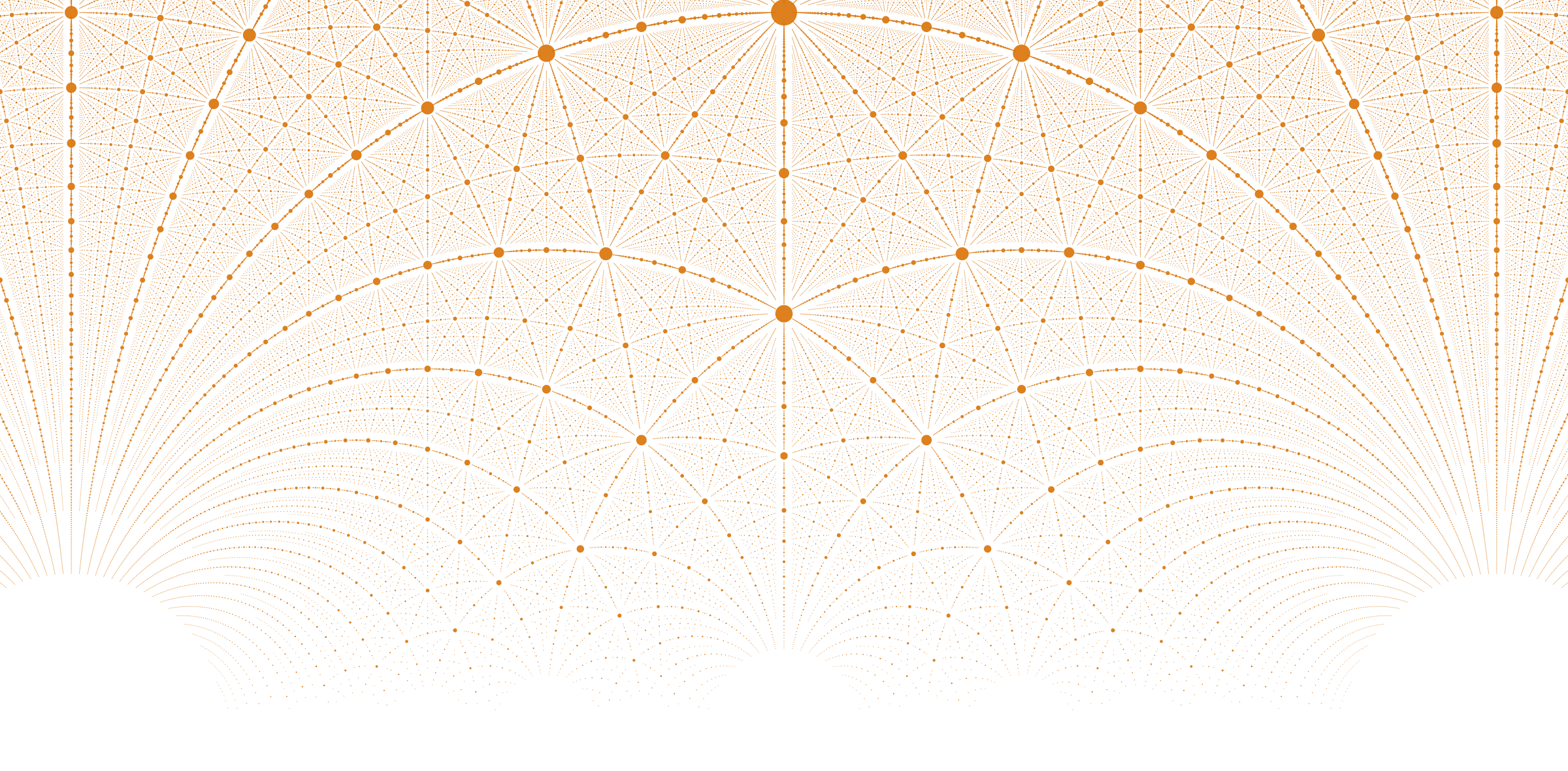
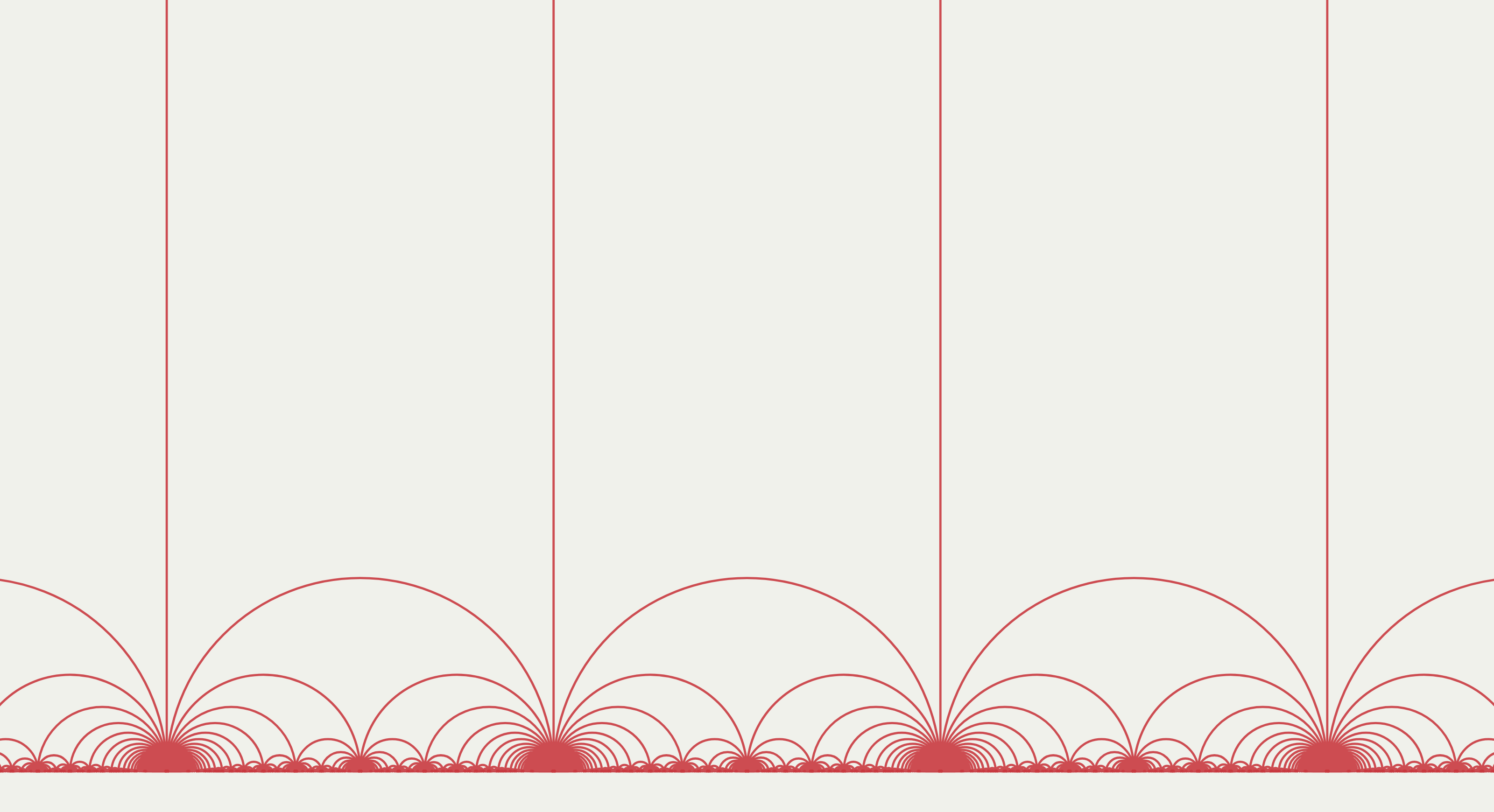
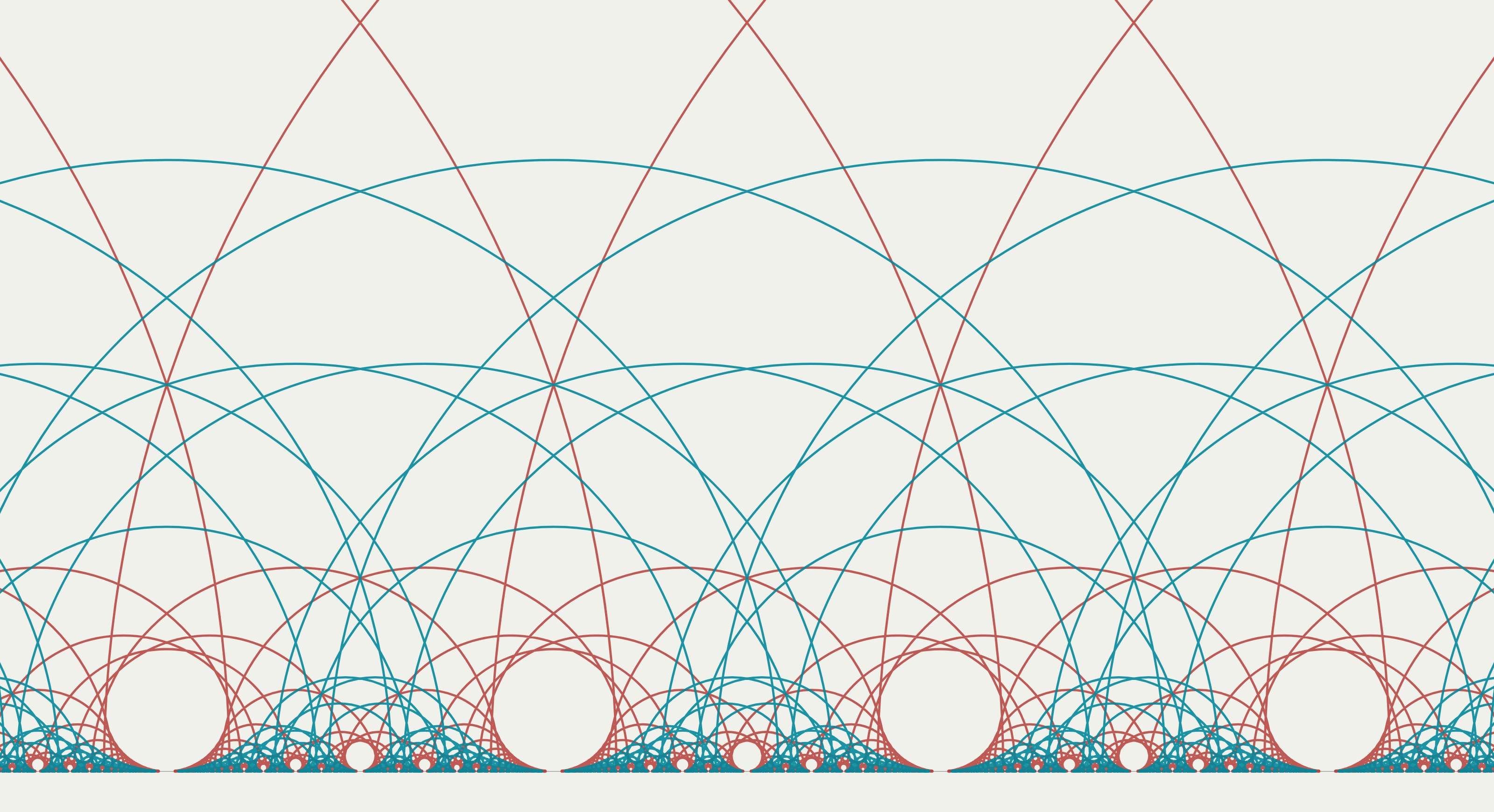
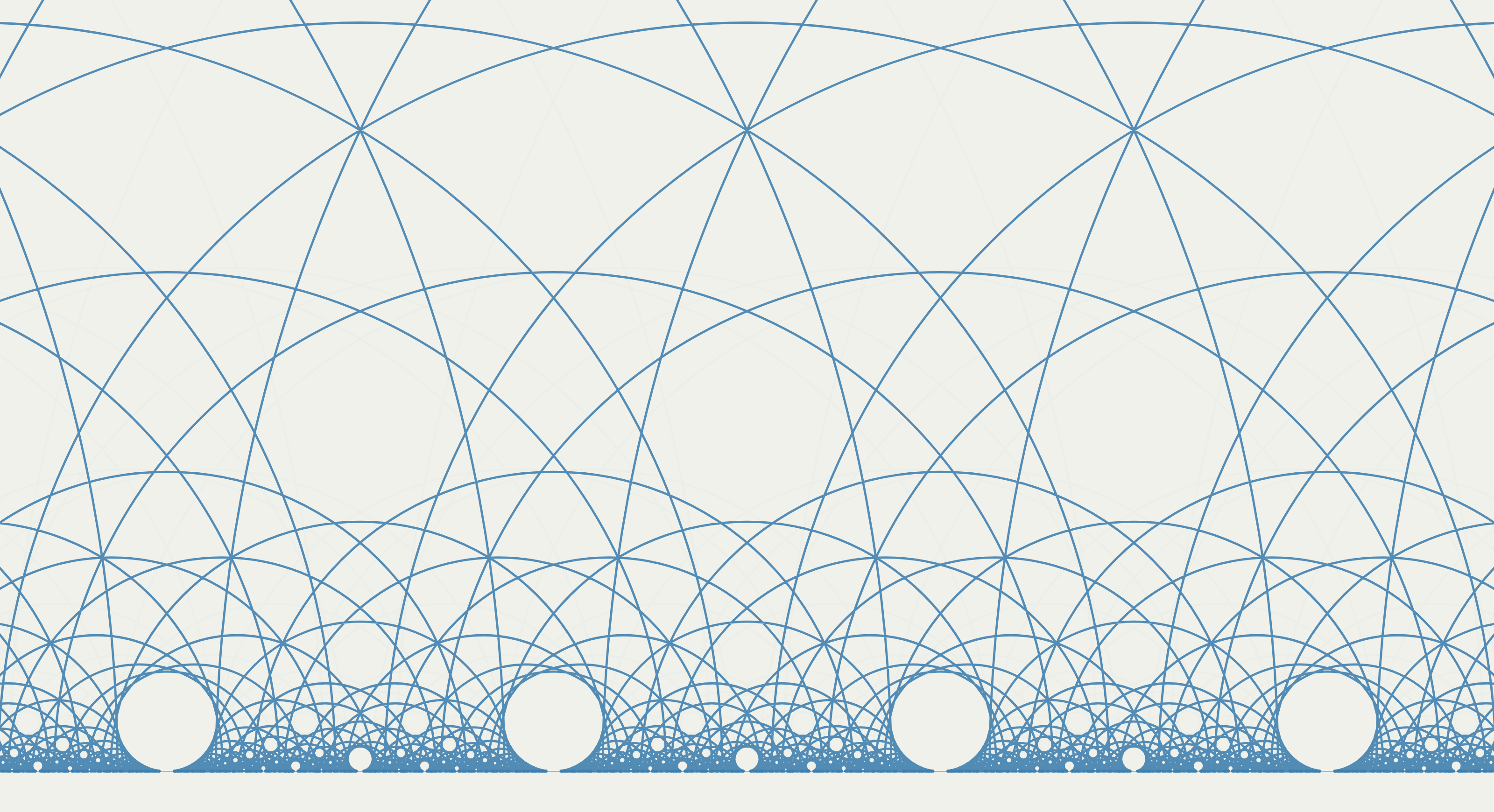
geodesics of the forms \(ax^2+bxy+cy^2\) with \(b^2-4ac = 1\): the Farey tessellation
![]()
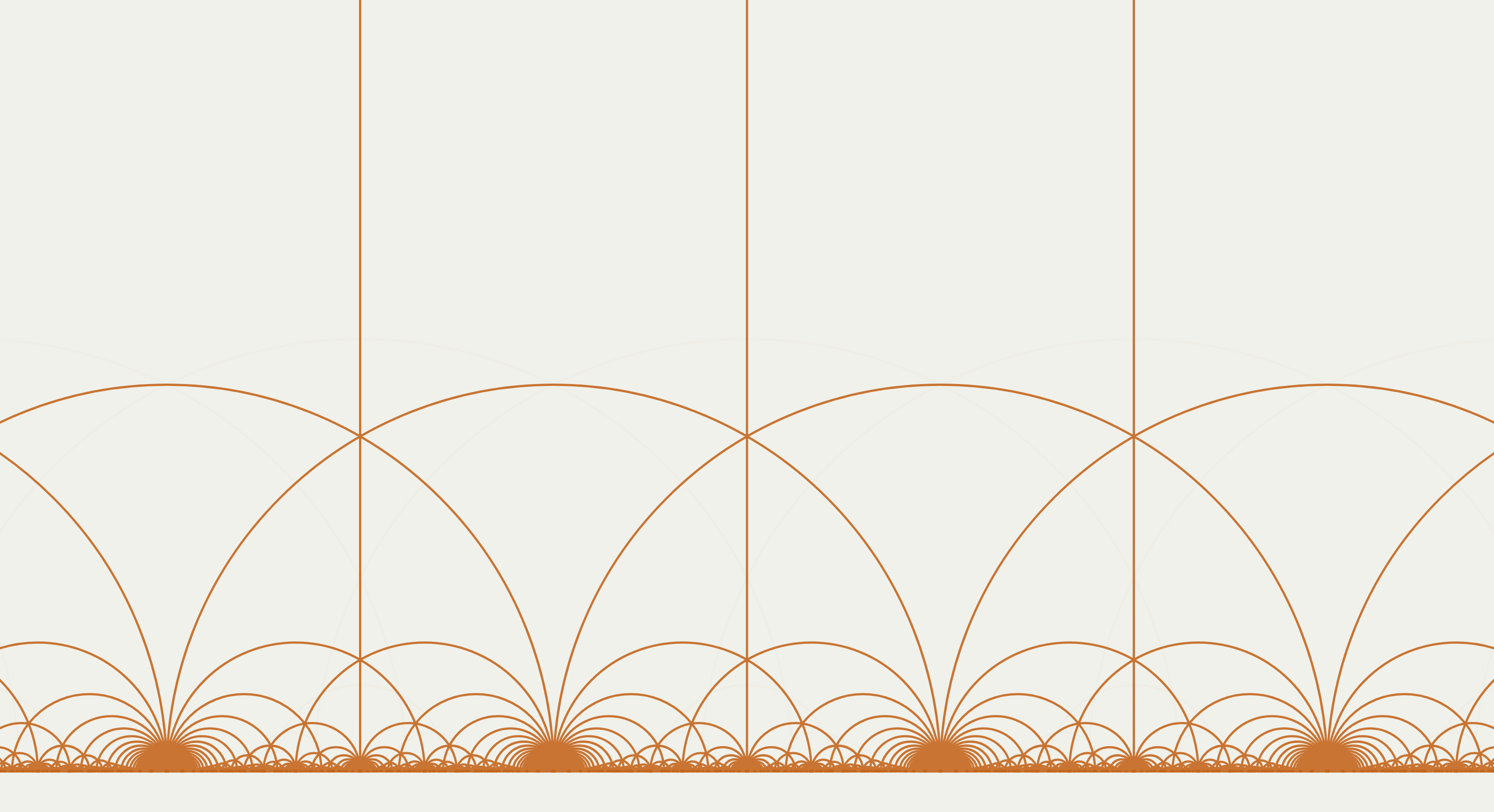
\(b^2-4ac = 4\): fundamental domains of \(\SL(2,\ZZ)\)
![]()
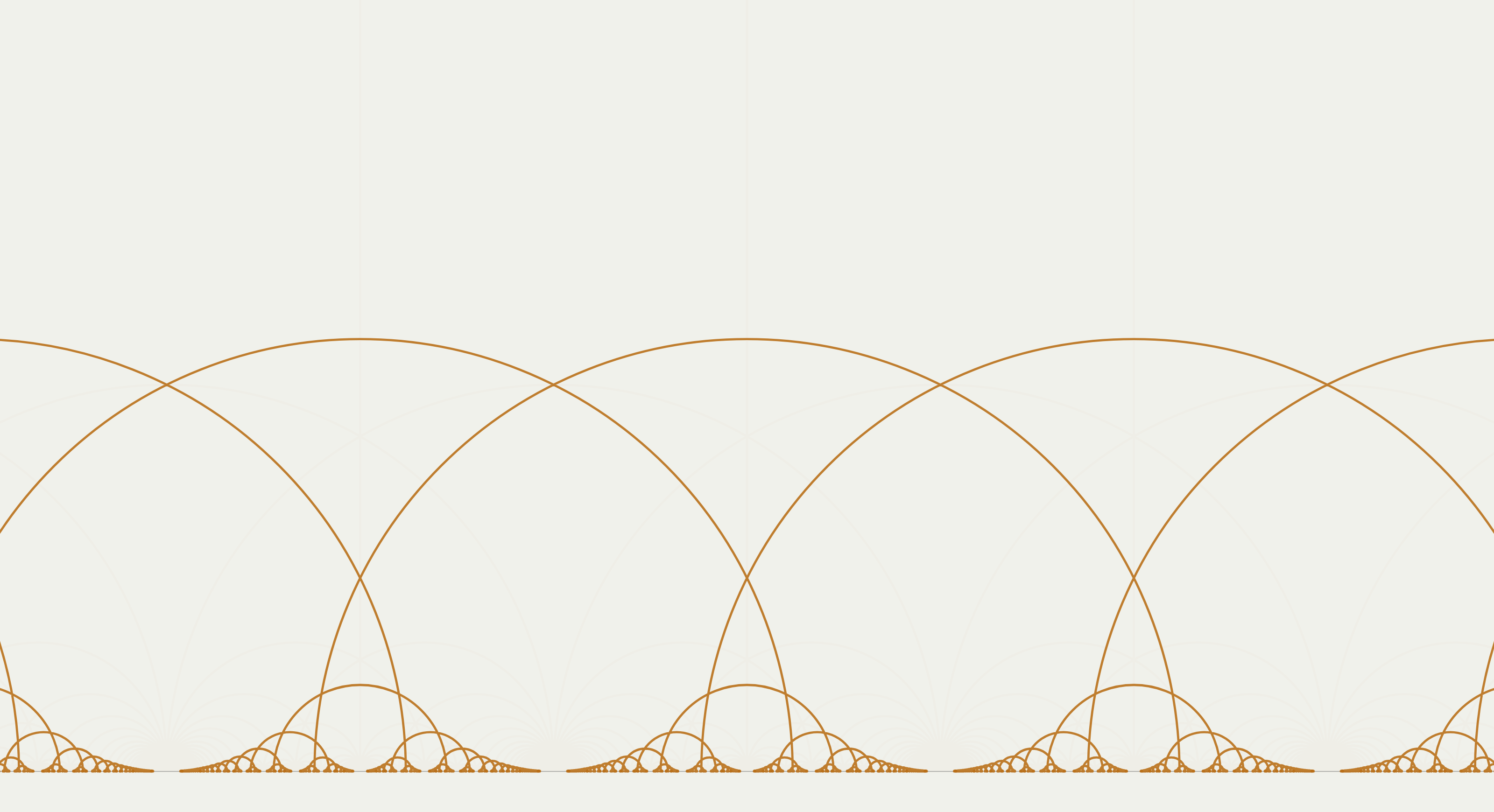
\(b^2-4ac = 5\)
![]()
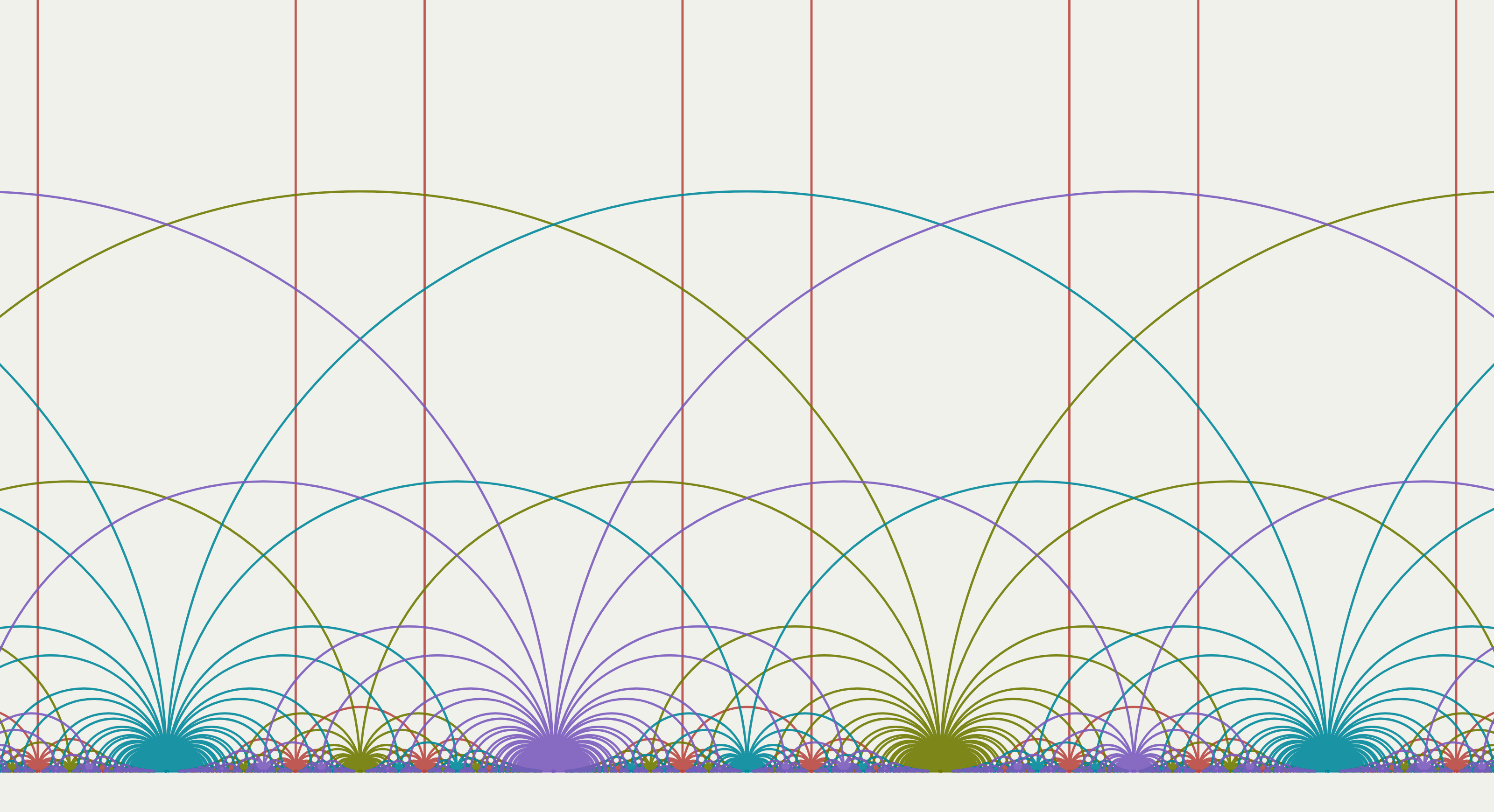
\(b^2-4ac = 9\), coloured by index-\(3\) sublattice of \(\ZZ^2\)
![]()
\(b^2-4ac = 40\), coloured by ideal class
![]()
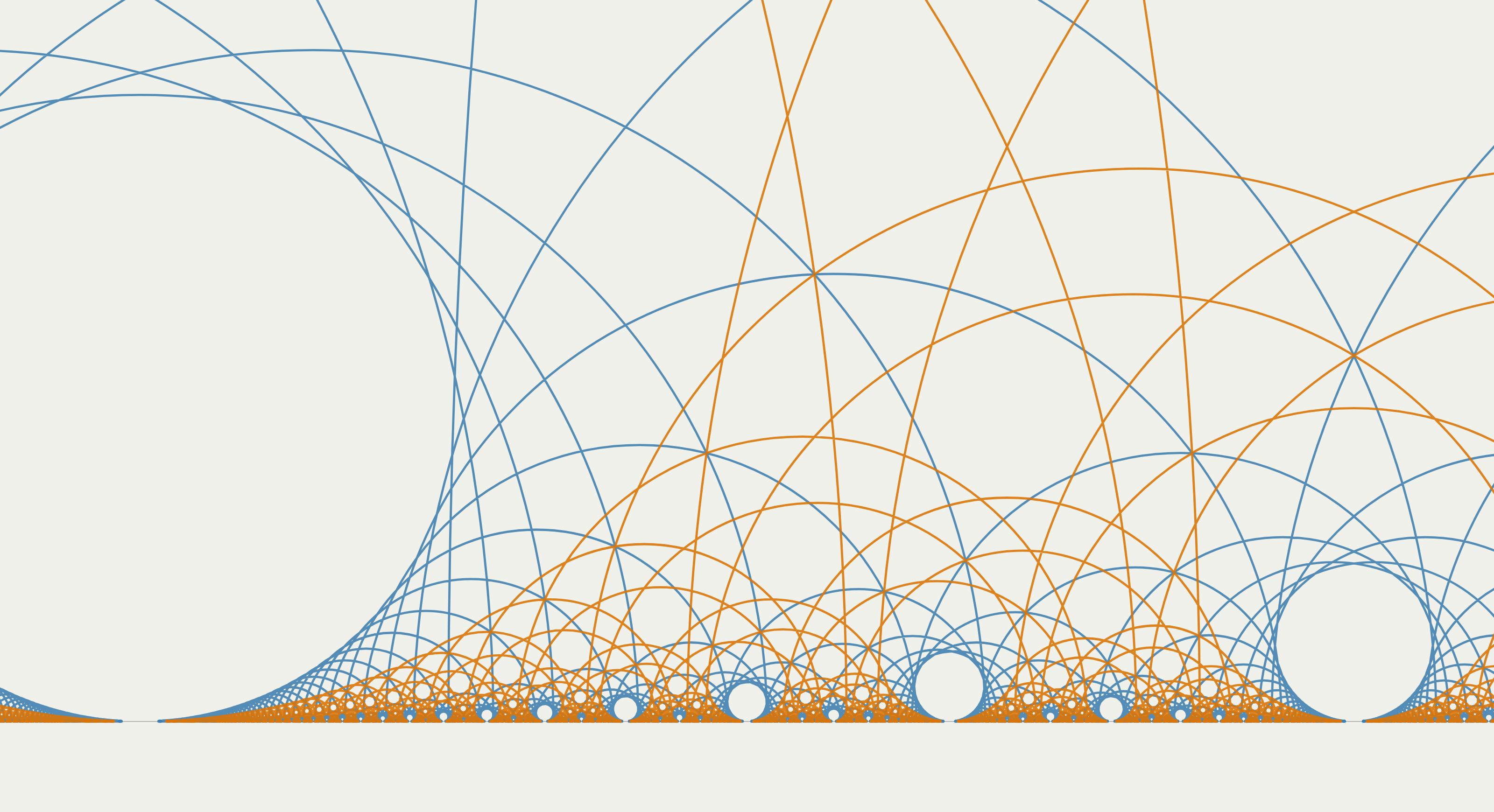
geodesics of the forms \(ax^2+bxy+cy^2\) with \(b^2-4ac = 60\)
![]()
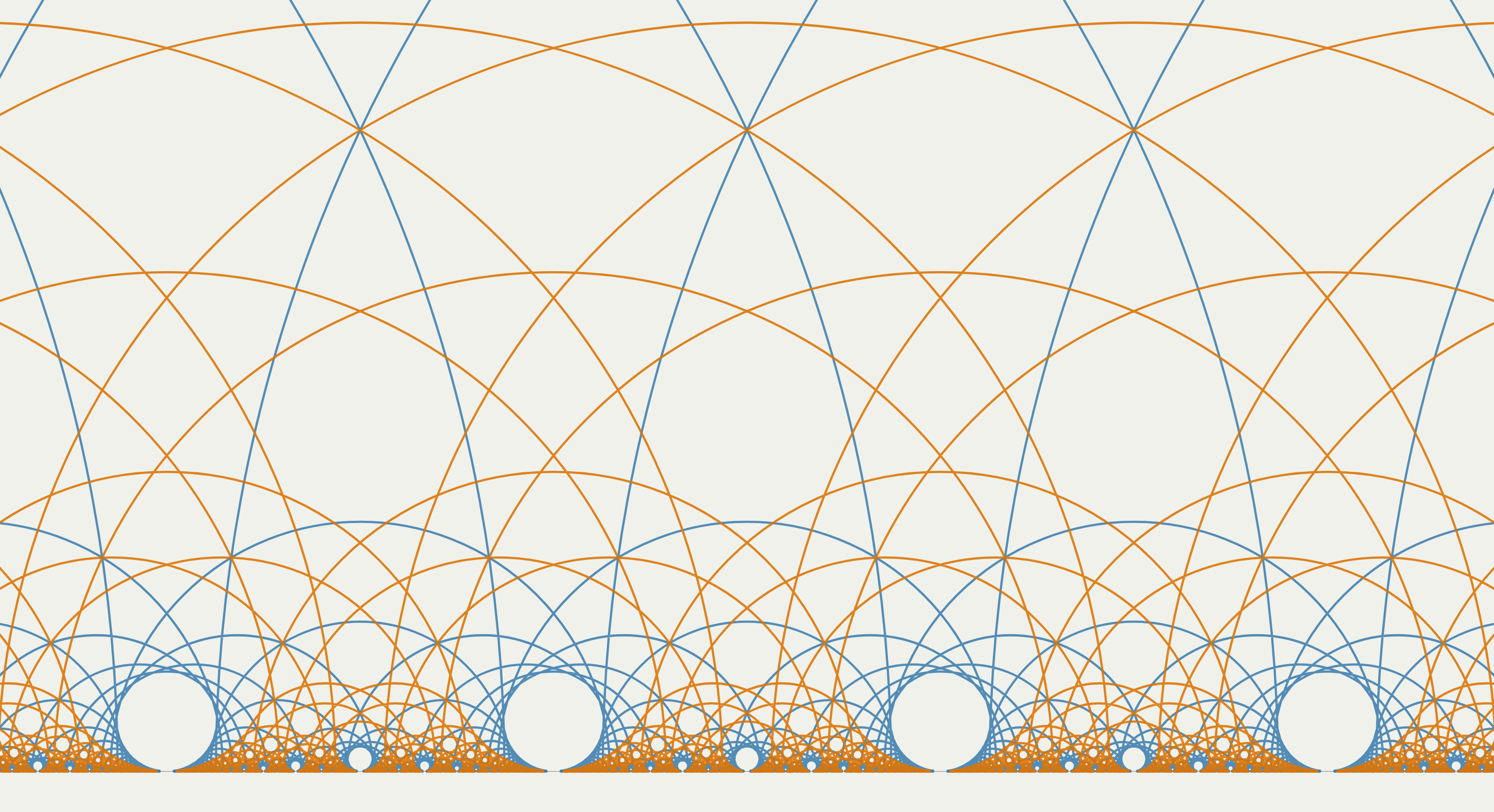
\(b^2-4ac = 60\), coloured by \(\SL(2,\ZZ)\)-orbit: two closed geodesics on the modular surface
![]()
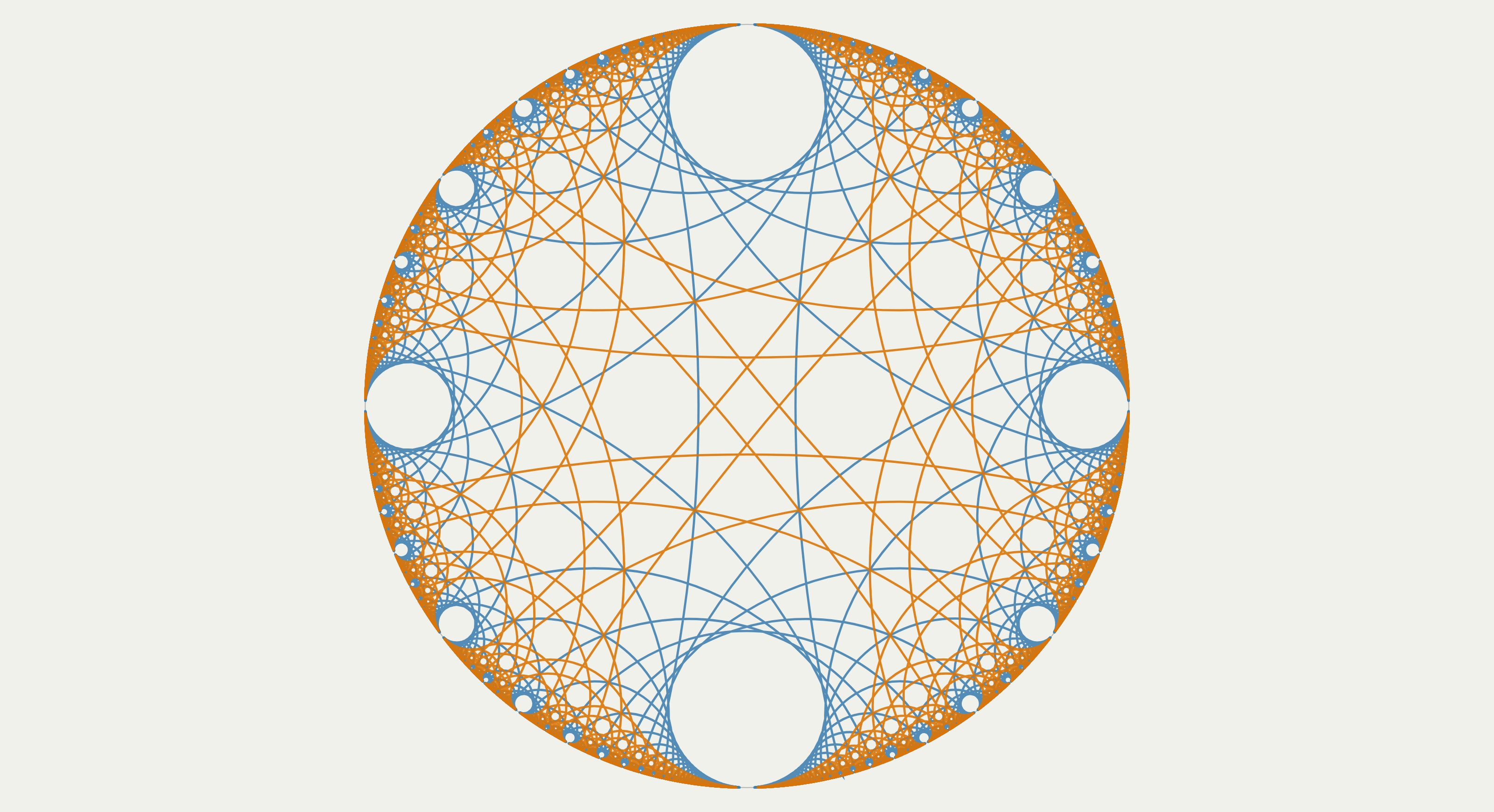
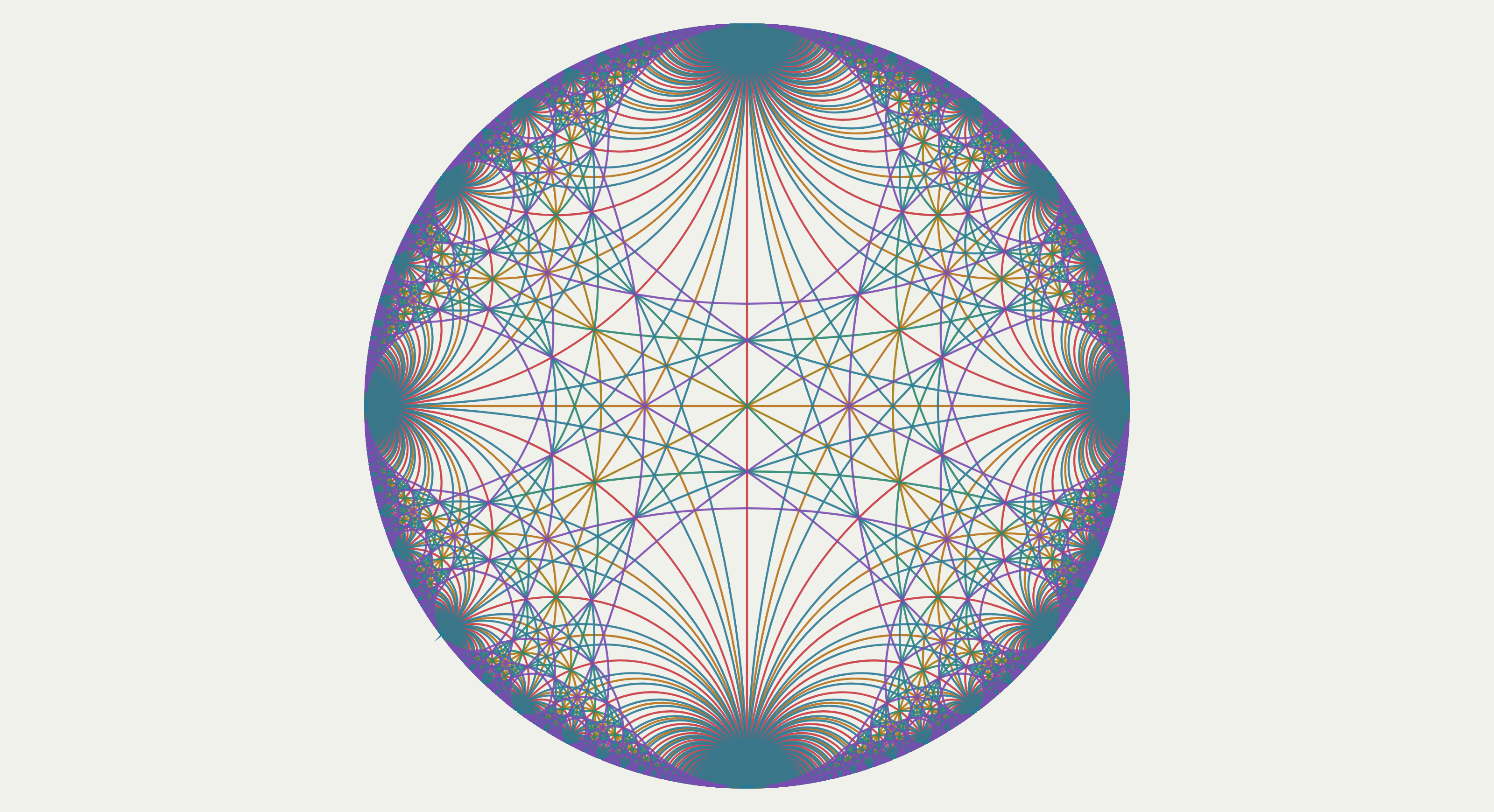
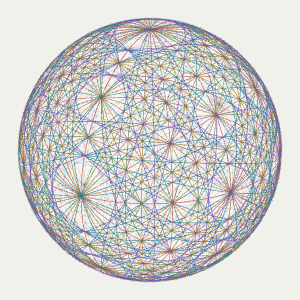
\(b^2-4ac = 60\) in the disk
![]()
\(b^2-4ac = 60\), zoomed in
![]()
all \(b^2-4ac \le 12\), coloured by norm
![]()
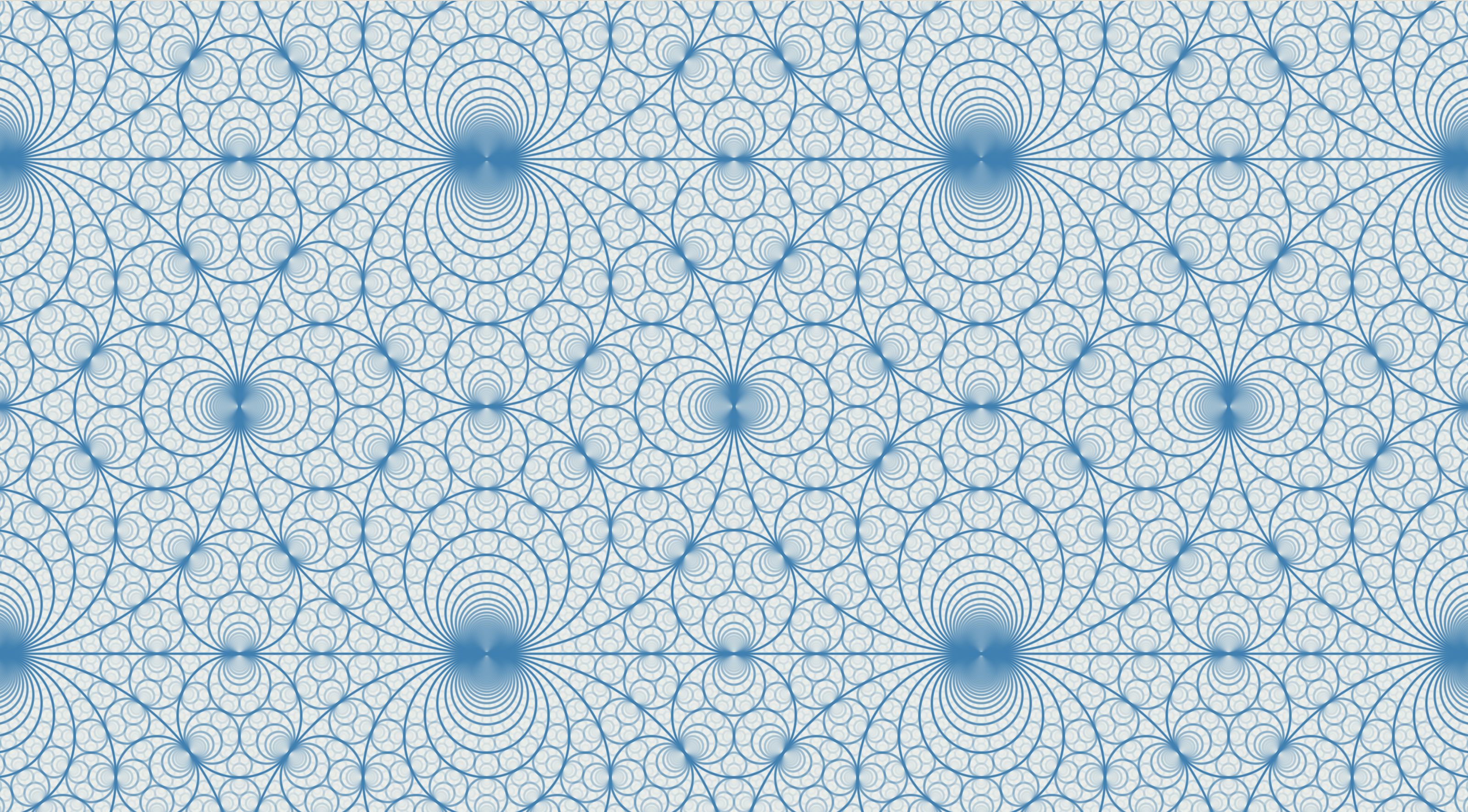
orbit of the real line under \(\PSL_2(\ZZ[i])\)
![]()
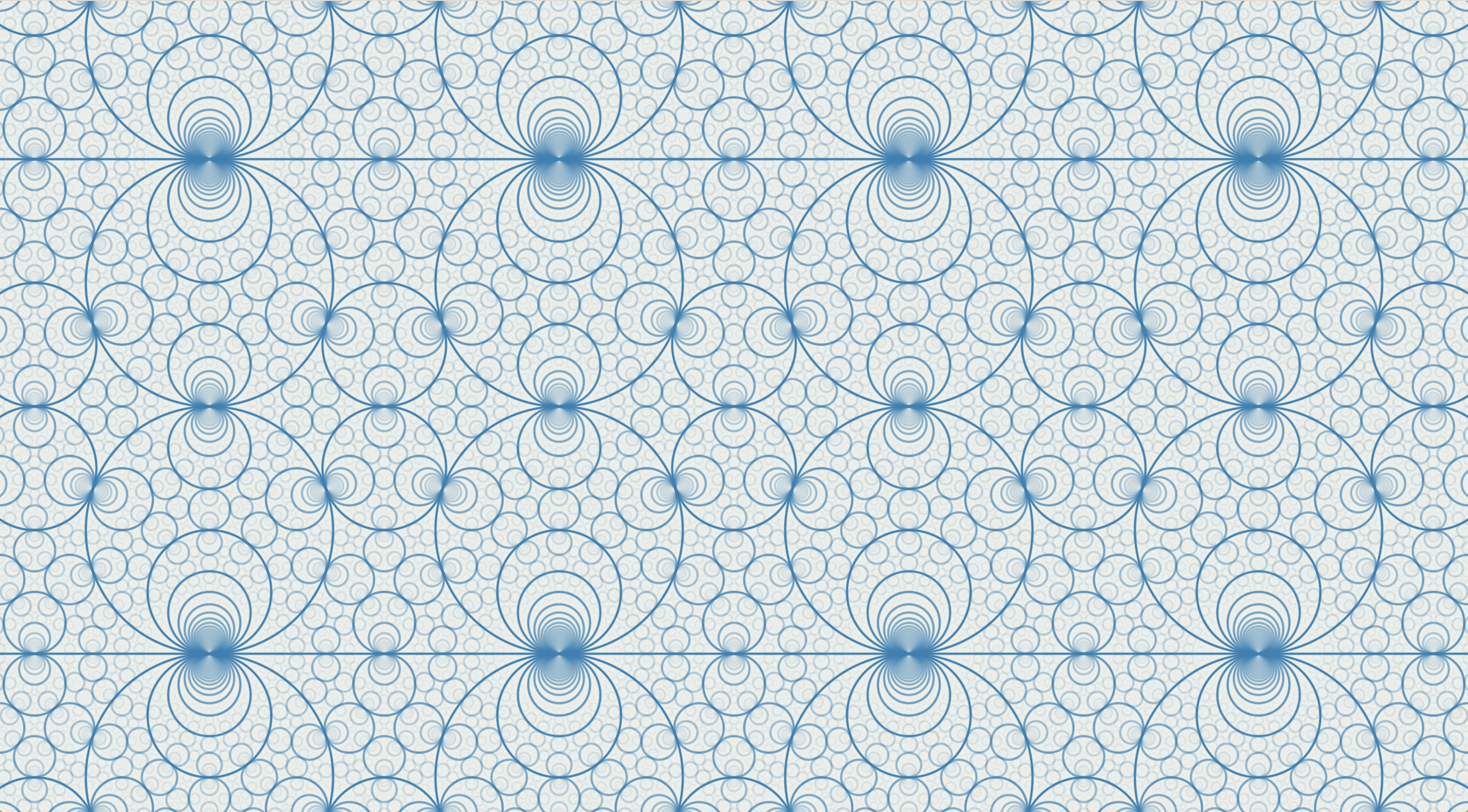
orbit of the real line under \(\PSL_2(\ZZ[\sqrt{-2}])\)
![]()
orbit of the real line under \(\PSL_2(\ZZ[\tfrac{1+\sqrt{-7}}{2}])\)
![]()
orbit of the real line under \(\PSL_2(\ZZ[\tfrac{1+\sqrt{-11}}{2}])\)
![]()
orbit of the real line under \(\PSL_2(\ZZ[\sqrt{-6}])\)
![]()
orbit of the real line under \(\PSL_2(\ZZ[\tfrac{1+\sqrt{-15}}{2}])\)
![]()
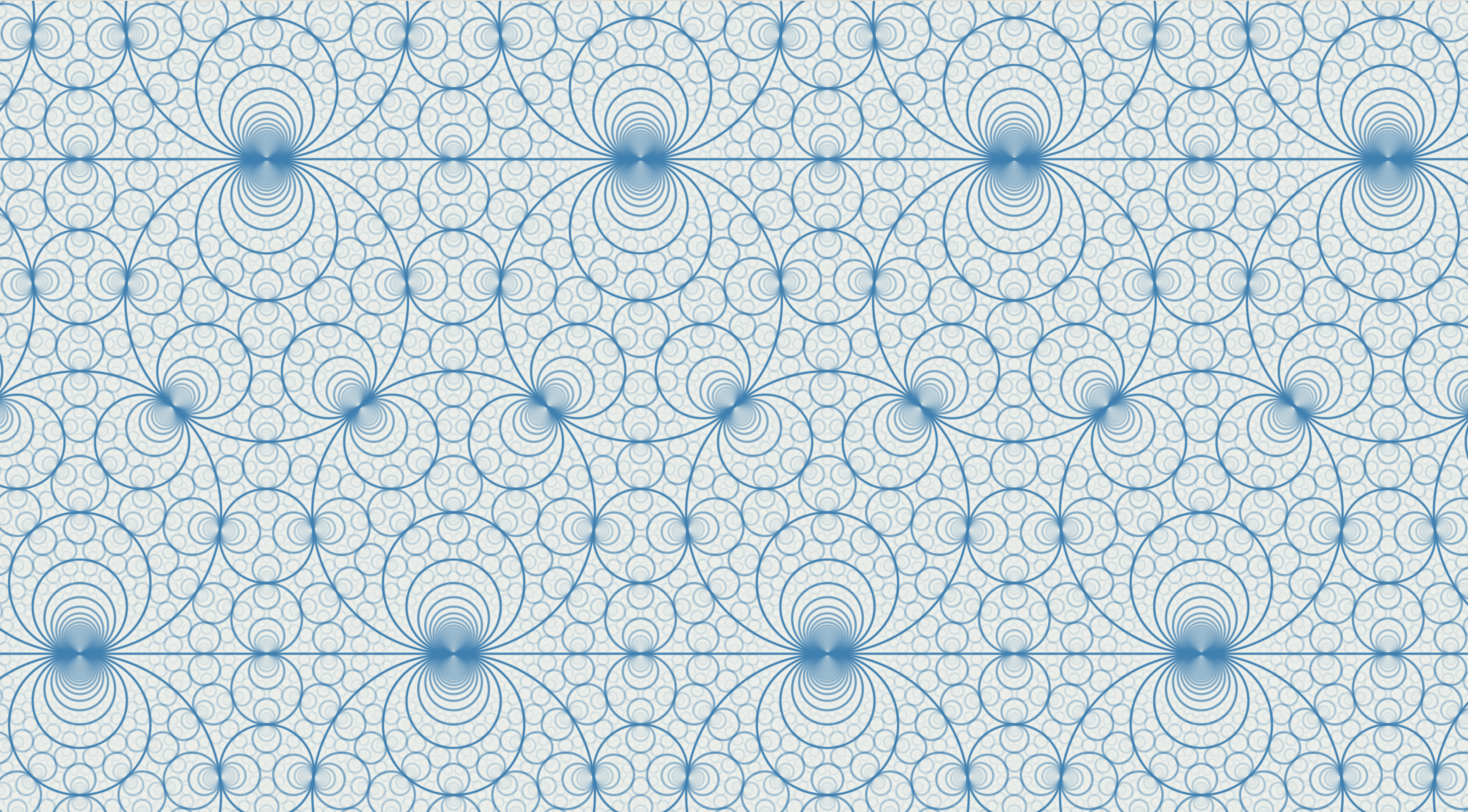
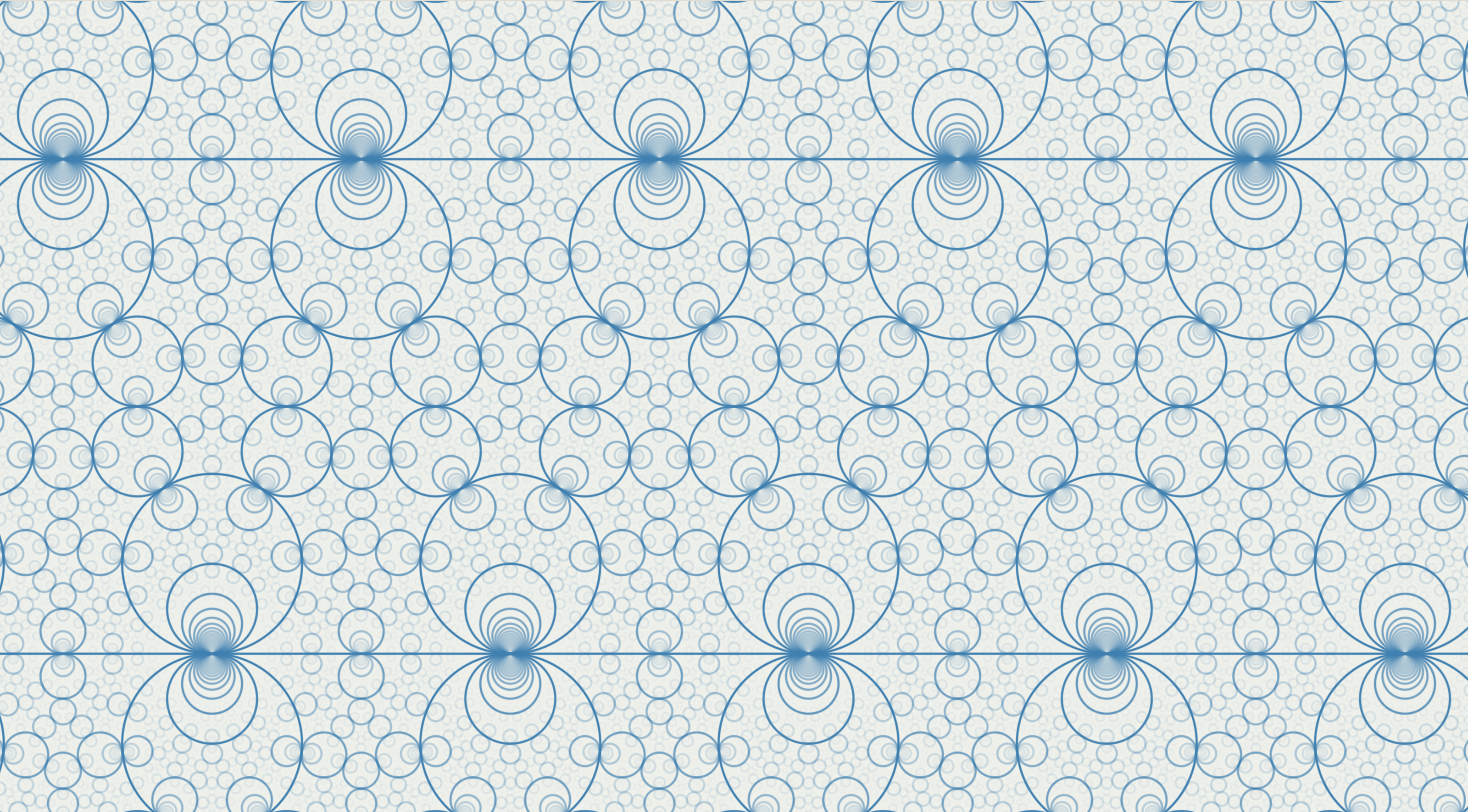
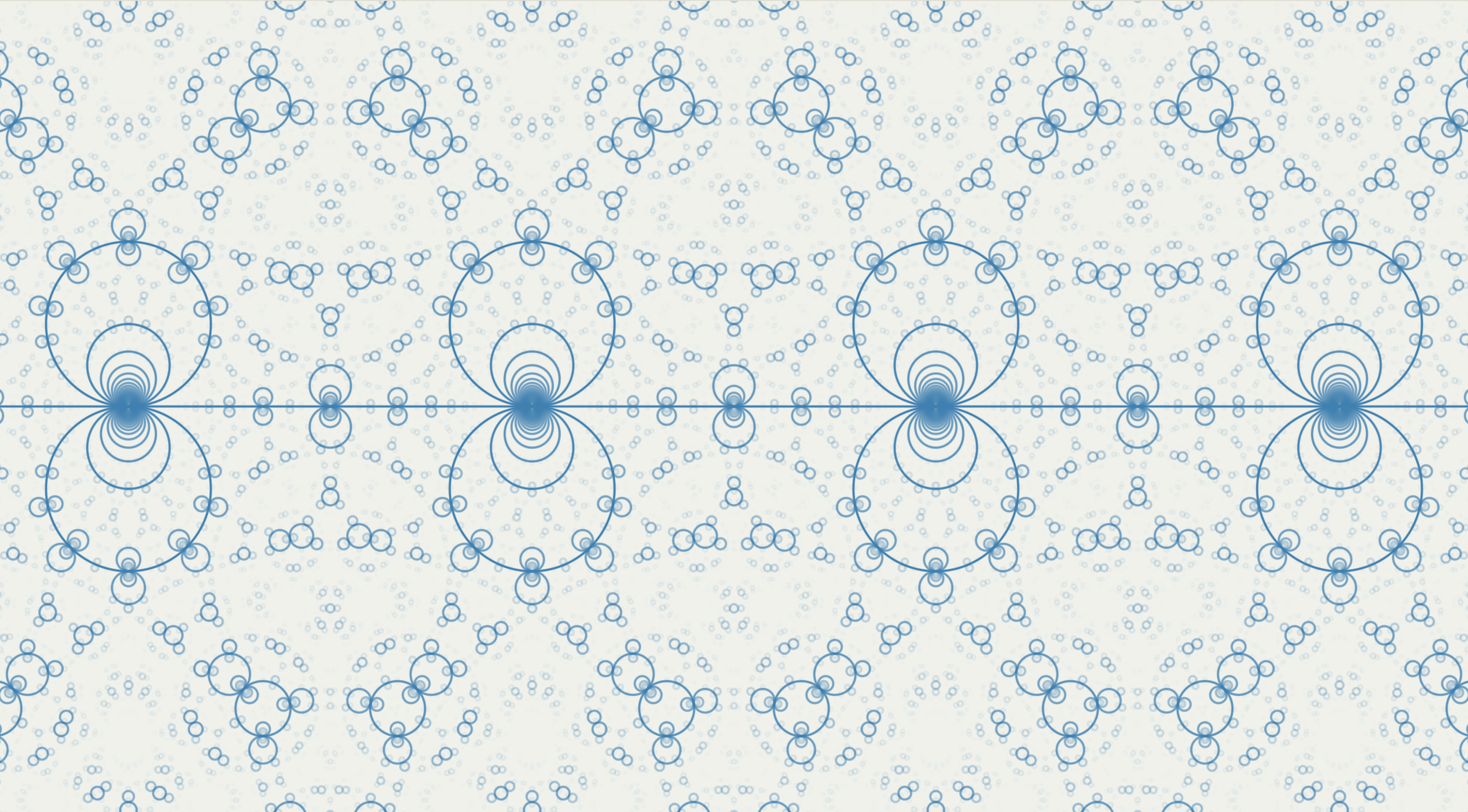
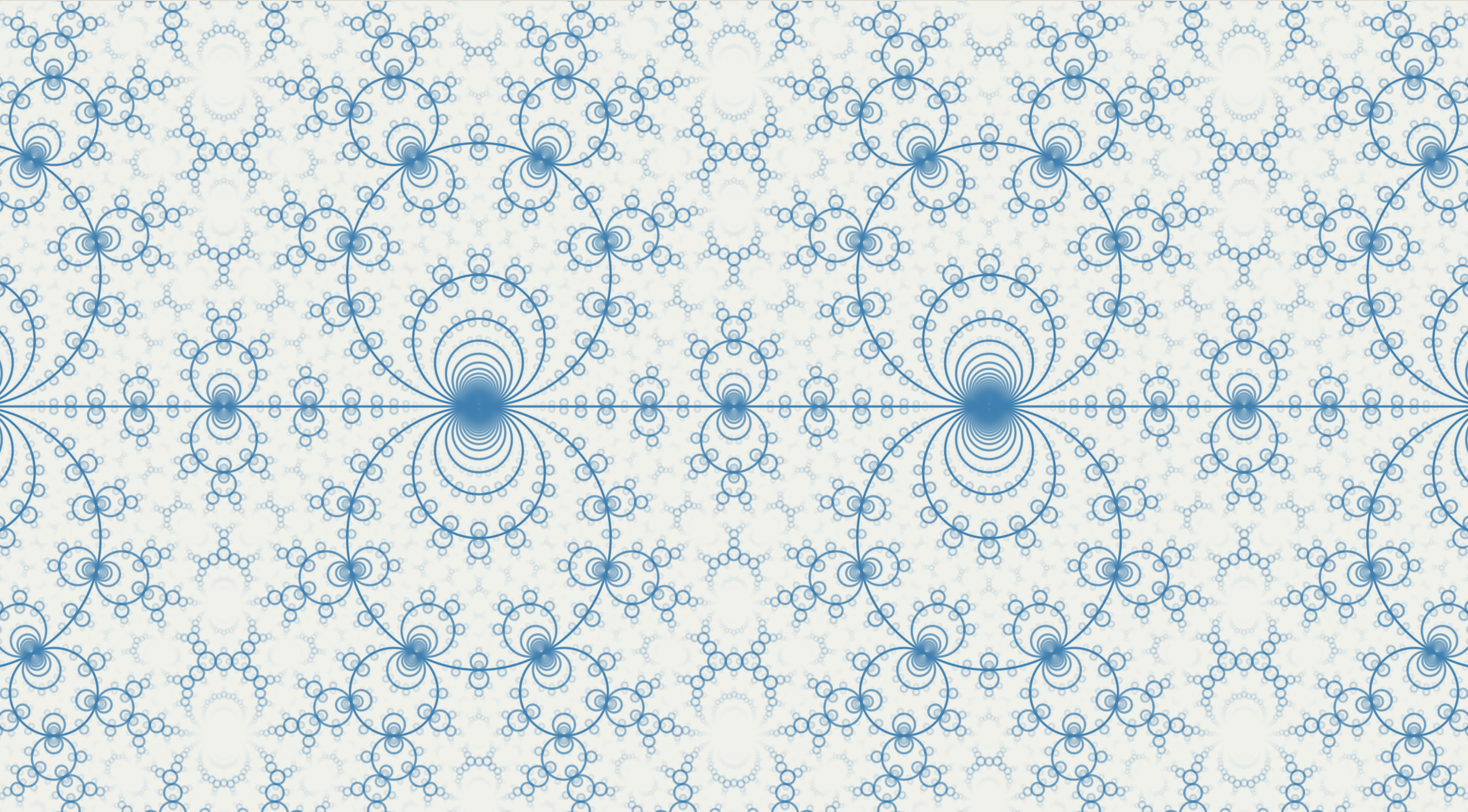
Euclideanity = tangency (or topological) connectedness
![]()
Euclideanity = tangency (or topological) connectedness
![]()
Thank you
“Beauty is truth, truth beauty.” — John Keats, Ode on a Grecian Urn